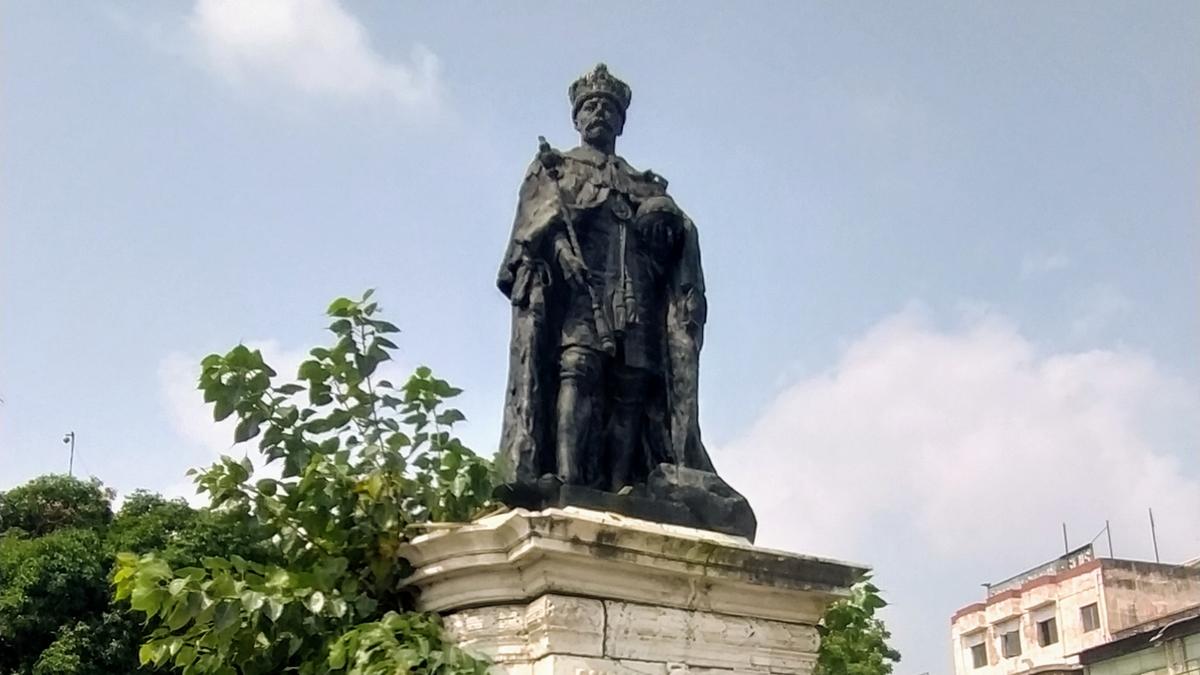
A view of the statue in 2021
| Photo Credit: Sriram V.
Last week, I went to George Town after a considerable hiatus. Walking there, always a challenge, becomes more so for me, as practically every nook and cranny is a lesson in history. The area is also, sadly, a perfect instance of how not to maintain a heritage precinct. For all that we are repeatedly told that we need to look to Singapore as our role model, in my view, it should be Galle in Sri Lanka or George Town in Malaysia that we need to look to for what can be done with our George Town.I was also much saddened by the many familiar landmarks that seem to have vanished to make way for tasteless commercial buildings and high rises in an area that can scarcely accommodate any further congestion. I wonder who is responsible for giving permissions for such buildings. But then, as a Commissioner of the Greater Chennai Corporation famously told the High Court of Madras a few years ago, 90% of buildings in George Town are in violation of some code or the other. So perhaps, nobody is really in charge.The Corporation seems to have added to the chaos in recent times. For a century and more, the rear of the Flower Bazaar police station had a triangle with a statue of King George V in its midst. The statue itself was funded by the Govinddoss Chaturbhujadoss family, wealthy Gujarati magnates of George Town and among the financiers of the Buckingham and Carnatic Mills when they were begun in the 1860s. The statue’s sponsor was Kushaldoss Chaturbhujadoss “on behalf of the citizens of Madras.” The sculptor was Sir Bertram Mackennal. Of Australian origin, he was something of a specialist on George V memorabilia, designing statues, stamps, and coinage.