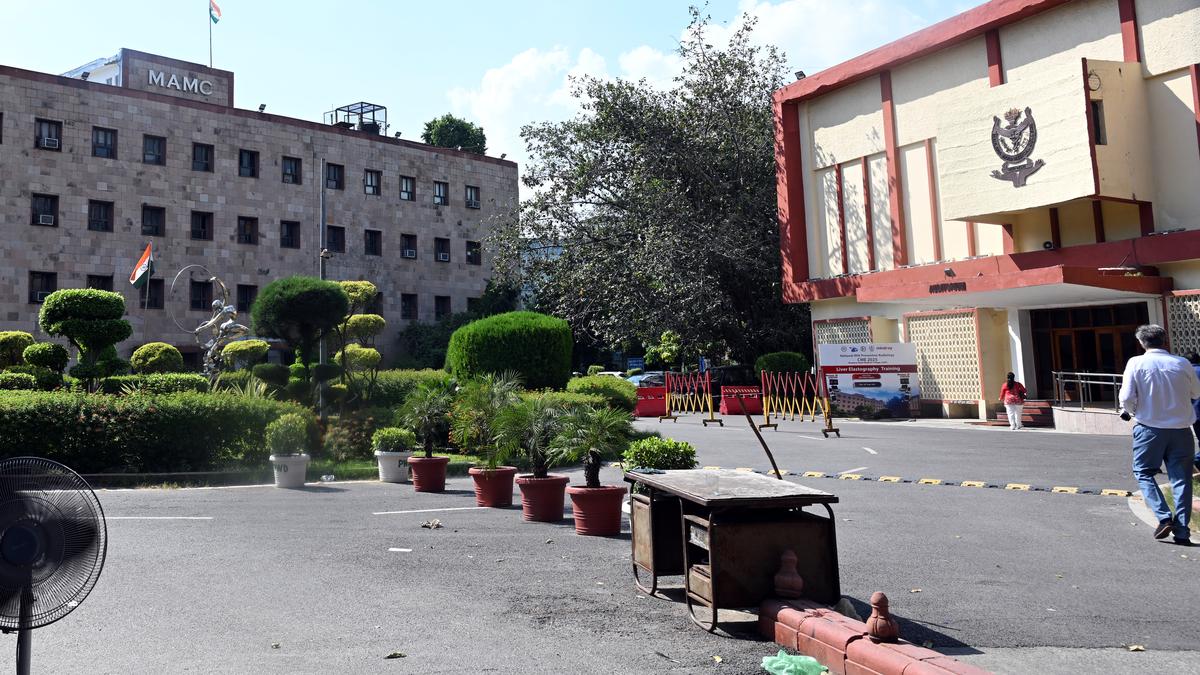
Maulana Azad Medical College is among the medical institutions in Delhi that will implement the bond policy from the 2025-2026 session.
| Photo Credit: SUSHIL KUMAR VERMA
Medical aspirants in Delhi are demanding the recall of a mandatory one-year service bond ranging from ₹15 lakh to ₹20 lakh, which is set to come into effect from the 2025-2026 academic session, calling it “financially burdensome” and fundamentally “restrictive” on their freedom of practice.Last year, the Delhi government notified that Lieutenant-Governor V.K. Saxena had approved a one-year service bond for undergraduate (UG) and postgraduate (PG) students in Delhi medical colleges/institutions, making it mandatory to serve in the Capital for at least one year after completing the course.The students would be required to furnish a bond of ₹15 lakh for UG courses and ₹20 lakh for PG courses, including super-speciality studies, at the time of admission. The bond will stand forfeited in case the student opts out of the mandatory service period.The UG and PG students will receive the same stipends as junior and senior resident doctors for their service year, as per the notification.Maulana Azad Medical College and Guru Gobind Singh Indraprastha University have notified that the bond policy will be implemented from the 2025-2026 session.The academic session is scheduled to begin soon after the conclusion of the National Eligibility cum Entrance Test (NEET) counselling, which is underway for the UG courses, and is yet to commence for the PG courses.‘Limits future options’A 26-year-old Doctor of Medicine (MD) aspirant from Rajasthan, who requested anonymity, said, “Like many other students, I was hoping to get into a Delhi college because it previously had no bond policy. With the new rule, I have to reconsider my options.”“For many of us, returning to our home town for practice is a top priority, besides opting for higher education. But if we have to pay such hefty fines, our future options get limited. If there is an emergency situation and we leave the service period midway, we have to pay ₹20 lakh,” said the student.Another medical student, also requesting anonymity, said, “Students have long preferred Delhi for its no-bond policy. Implementing the bond system will actively discourage applicants from other States who wish to study in Delhi.”Another medical student said that since Delhi is widely regarded as a favoured place to work, implementing such a bond “appears unnecessary”.Across the country, several States have such a bond policy, but the amount varies, leading students to prefer one State over another based on college rankings, course fees, and bond amounts. Haryana has a bond of ₹20 lakh to ₹25 lakh, whereas Puducherry and the All India Institute of Medical Sciences (AIIMS) have no bond policy in place.‘Abolish bond system’The Federation of Resident Doctors’ Association (FORDA) has maintained that the bond system should be abolished altogether. Calling it “regressive”, FORDA general secretary Dr. Sarada Prasad Sahoo said, “The objective behind the bond is to solve the shortage of doctors. However, the process of its implementation remains unclear. For instance, if there are 200 students in a batch, will they all be absorbed by the parent institute [medical college/institute], and does the parent institute have the necessary infrastructure for all 200 doctors?” Published - September 30, 2025 01:21 am IST