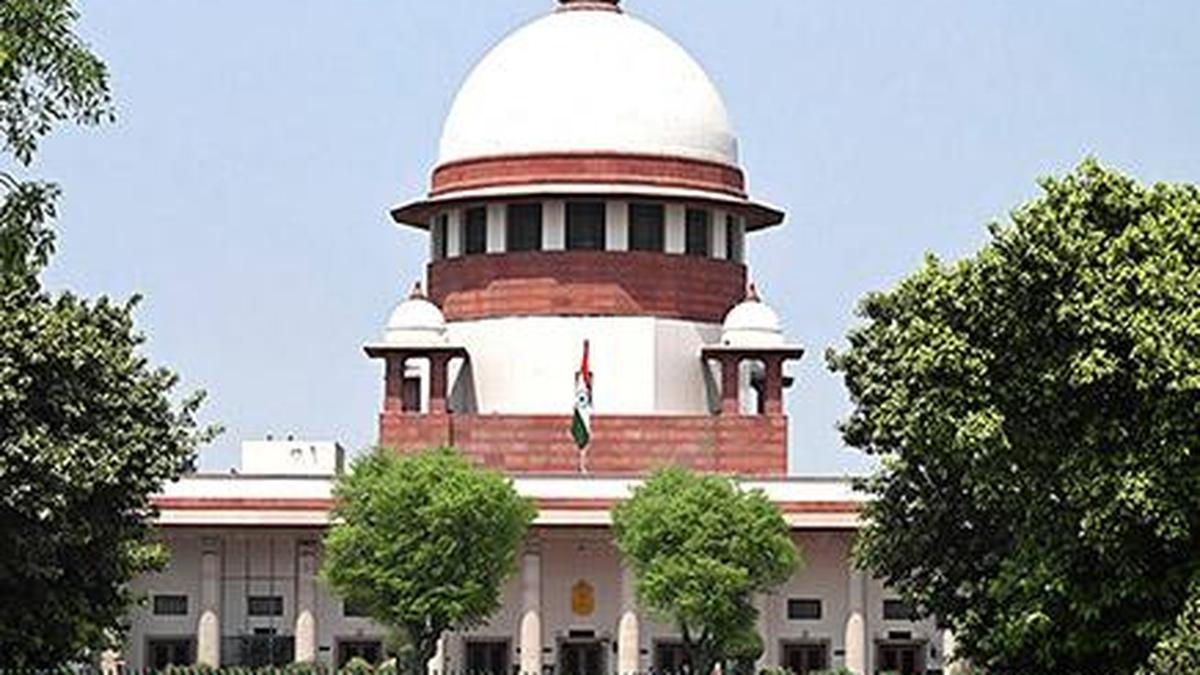
The ruling stemmed from a case involving Dharam Pal Singh Rathore and his wife, Shiksha Rathore, who were accused of duping Netsity Systems Private Limited through a fraudulent land deal. File
| Photo Credit: PTI
The Supreme Court has directed two judges at Delhi’s Karkardooma courts to undergo a week-long “special judicial training” after censuring them for the manner in which they granted bail in a ₹1.9-crore cheating case. A Bench of Justices Ahsanuddin Amanullah and S.V.N. Bhatti found that the judges had disregarded binding precedents and “glossed over” material facts while releasing the accused.The ruling stemmed from a case involving Dharam Pal Singh Rathore and his wife, Shiksha Rathore, who were accused of duping Netsity Systems Private Limited through a fraudulent land deal. The Delhi High Court had earlier refused them anticipatory bail, castigating the couple for misleading the court and furnishing false undertakings. Nevertheless, they went on to obtain bail from an Additional Chief Metropolitan Magistrate (ACMM) in November 2023 and from a sessions judge in August 2024.“We would be failing in our duty if we turned a blind eye to the manner in which the ACMM granted bail to the accused and the sessions judge refused to interfere… In these facts, we deem it appropriate that the judicial officers shall undergo special judicial training for a period of at least seven days,” the Bench observed.The Chief Justice of the Delhi High Court has been tasked with organising the programme at the Delhi Judicial Academy, with a focus on sensitising judges to the binding effect of superior court rulings and to the need for a rigorous appraisal of an accused’s conduct in bail proceedings. The chairperson of the Judicial Education and Training Programme Committee has also been directed to incorporate these aspects in future training modules.‘Serious lapse’The court did not confine its censure to the judicial officers. It also directed the Delhi Police Commissioner to conduct a personal inquiry into the role of the investigating officers (IOs), who had downplayed the need for custodial interrogation. Terming this a “serious lapse,” the Bench said the IOs’ stance in the bail proceedings “spoke volumes” and instructed the Commissioner to initiate appropriate action on priority.In a pointed observation, the court said the reasoning adopted by the ACMM in granting bail “bordered on perversity.” It noted that, despite the Delhi High Court’s adverse findings in February 2023, documenting the accused’s repeated false undertakings and involvement in earlier cheating cases, the magistrate had proceeded on the assumption that the filing of a charge sheet dispensed with the need for custody. The sessions judge, it added, aggravated the error by limiting his assessment to the accused’s conduct after bail rather than scrutinising the legality of the magistrate’s order.Emphasising that bail decisions must rest on facts and conduct rather than mechanical reasoning, the court observed, “Bail matters are primarily to be adjudicated on the facts and circumstances, before applying any principle of law. In light of the glaring factual matrix, bail ought not to have been granted.”Procedural lapsesThe court also flagged procedural lapses. It noted that although the couple had presented themselves before the ACMM in October 2023 seeking bail and were technically in judicial custody, no interim release order was issued. Nevertheless, they remained at liberty until bail was formally granted in November 2023 upon furnishing bonds of ₹3 lakh each. “We are unable to comprehend how, having formally surrendered before the court, the accused were permitted to leave the court without any formal order of release,” the Bench remarked.Furthermore, the court held that the Delhi High Court had erred in treating the matter merely as one of bail cancellation, observing that it ought to have taken into account the accused’s past conduct and the surrounding facts before affirming the bail orders in November 2024. “We are also constrained to observe that the High Court ought to have appreciated the background facts and not treated the matter merely as one seeking setting aside of/cancellation of bail simpliciter,” it said.Setting aside the orders of the ACMM, the sessions judge, and the Delhi High Court, the Bench cancelled the bail and directed the couple to surrender within two weeks.The Bench clarified that its ruling did not attempt to dilute pro-liberty principles but underscored that such principles must be applied to the facts of each case as “no precedent operates in a vacuum.” Published - September 29, 2025 07:07 pm IST