Automotive giant Honda and lunar startup Astrobotic are teaming up to explore how a regenerative fuel cell system could help keep the lights on during long nights on the moon.
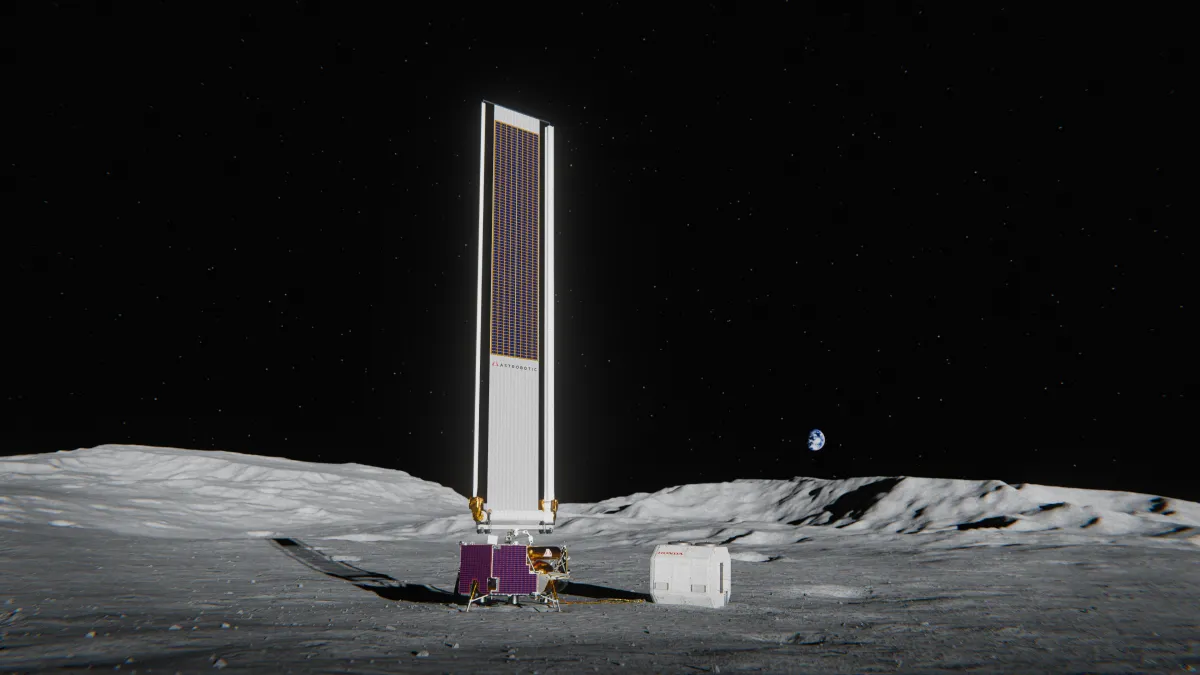
The companies on Monday partnered up to study whether Honda’s regenerative fuel cell (RFC) can be integrated into Astrobotic’s LunaGrid, a scalable power service built around solar arrays. The two will conduct “illumination studies” at potential lunar south pole landing sites, and evaluate system scalability as well as hardware and software integration.
A key challenge for lunar exploration is surviving the two-week-long lunar night, when temperatures can plunge to as low as -424 degrees Fahrenheit in some regions, while solar panels sit idle. Honda’s RFC addresses that problem by storing solar power as hydrogen during the lunar day and converting it back into electricity at night, producing water as the only byproduct.
That water is then recycled into a high-pressure electrolysis system to create more hydrogen, forming what Honda calls “a closed-loop energy cycle.”
Astrobotic’s Vertical Solar Array Technology (VSAT) is designed to track the sun for maximum energy capture, and is planned to have a capacity of up to 10 kilowatts. The company is also developing an XL version, which would generate five times more power.