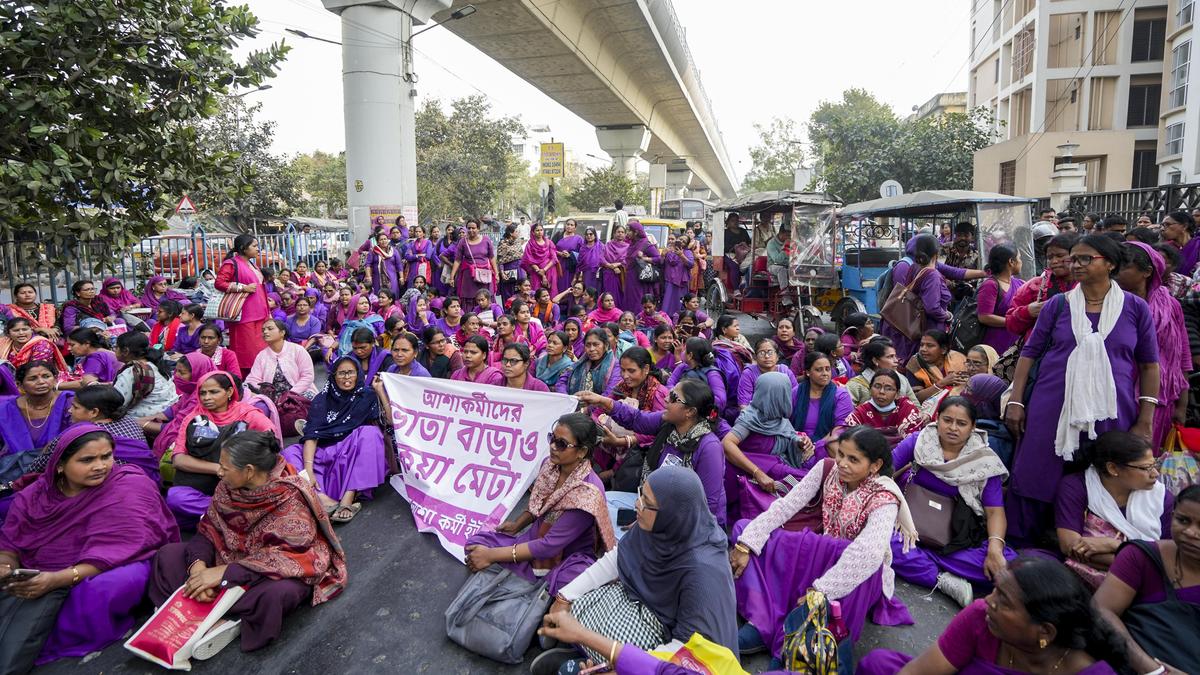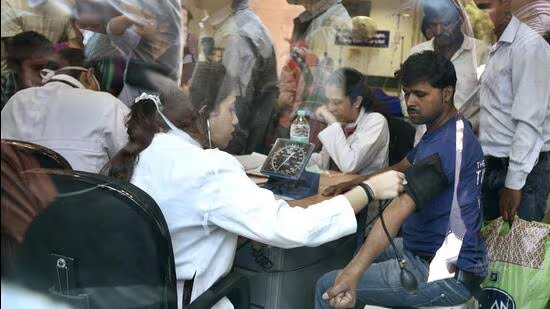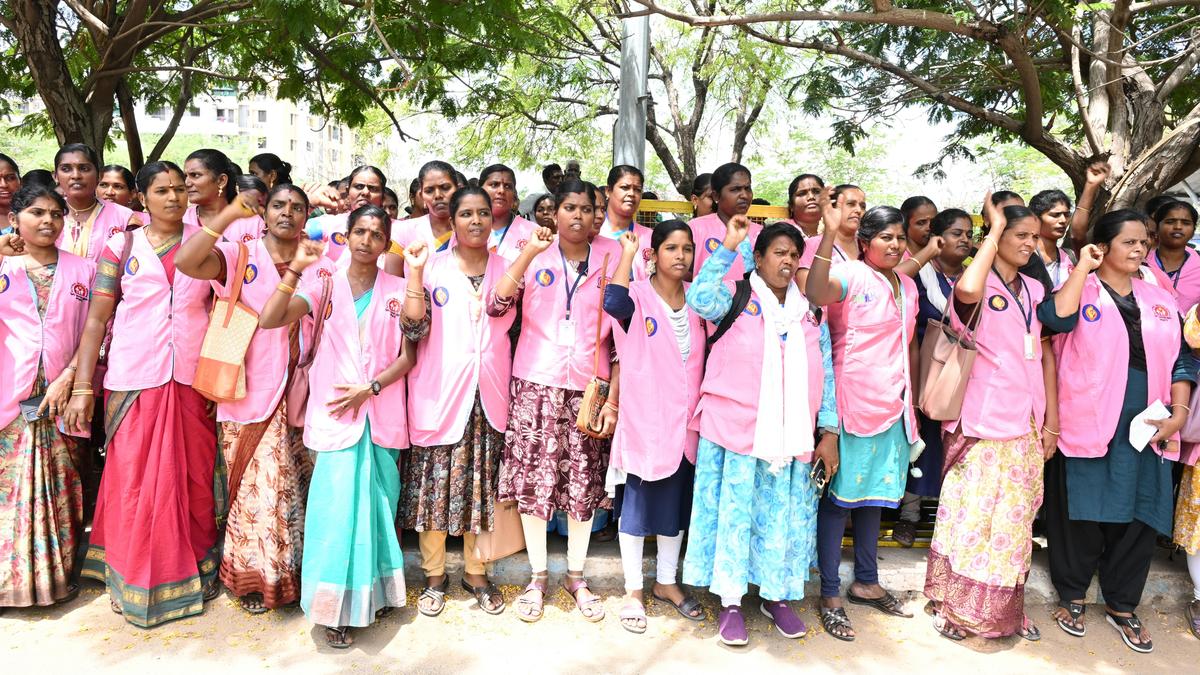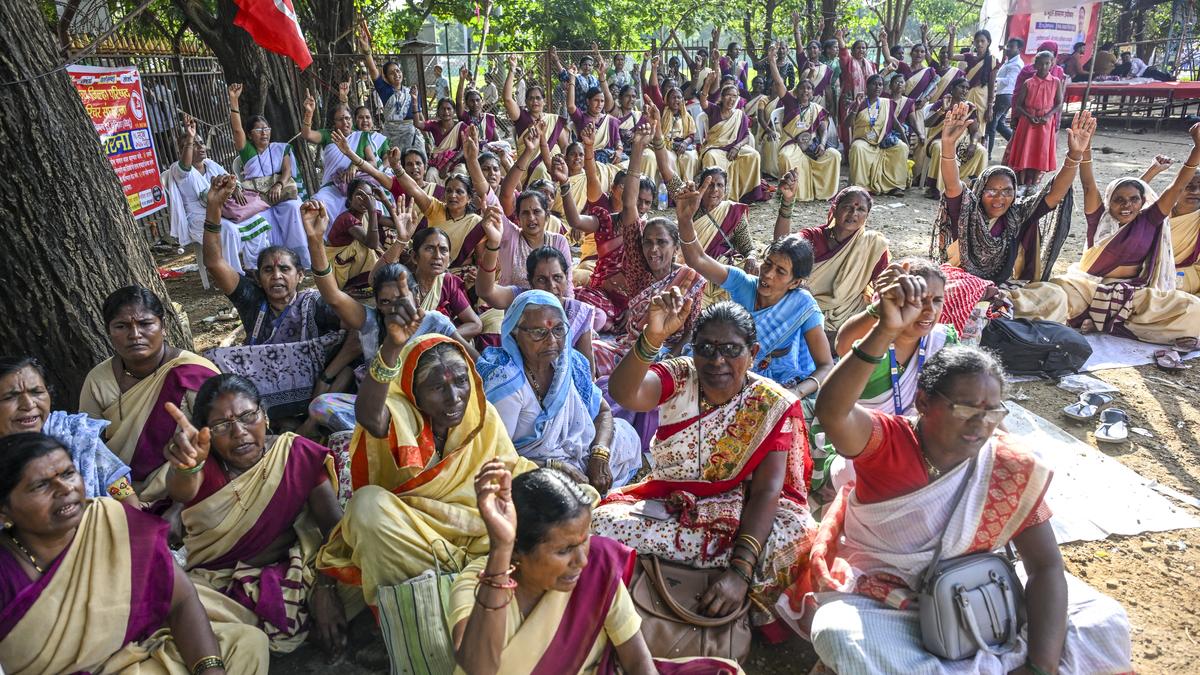
Braving the rains and heat, hundreds of Anshakalin Stree Parichar (part-time women healthcare attendants), from across Maharashtra, staged a protest from September 16 to September 26 at Mumbai’s Azad Maidan. On September 25, State Public Health and Family Welfare Minister, Prakash Abitkar, gave a verbal assurance that the State government will increase their salary from ₹3,000 to ₹6,000 before December 2025, urging the attendants not to protest anymore. However, the attendants do not feel confident about the half-hearted government assurance.During the protest, every day, slogans echoed across the ground, yet no Minister came to meet them. Mangala Arun Meshram, 55, the State president of the Mahila Parichar union, who came from Adam village in Kuhi taluka, Nagpur, said, “There are 10,673 attendants across Maharashtra who work closely with Auxiliary Nurse Midwife (ANM) in sub-centres and primary health centres (PHCs) in rural areas. A minimum qualification of till class 7 is required to get this job, and they learn at the healthcare units.”The Anshakalin Stree Parichar category was created in 1966 by Maharashtra’s Zilla Parishads. Although described as “part-time,” they work from 8 a.m. to 5 p.m. and sometimes overnight. They assist childbirths (often independently), conduct vaccination drives, door-to-door health surveys, patient care, assist in operation theatres, do regular check-ups such as blood-pressure, and do sanitation work such as sweeping, mopping, cutting grass in hospital compounds. They were even engaged in COVID-19-related tasks such as RT-PCR testing and vaccination.“We are also assigned to the government-run ayurvedic, allopathic and homoeopathic dispensaries,” Ms. Meshram said, adding that there are 700 such government-run dispensaries across the State where her colleagues work.Ms. Meshram has preserved proof of their work in the form of coloured photographs, along with a description of their work in a file. “We prepared these to present to the Ministers for whom we are invisible. From the sub-centre, we are sent to multiple locations, and to reach these locations, we walk for hours as we don’t get any travel allowance either,” she said.They work from Monday to Saturday, and in case of an emergency, such as childbirth or a health camp, they work extra hours at a salary of ₹3,000 per month, a wage unchanged since 2016, without pension or job security.“We deliver babies on our own, but the credit and incentives go to ANMs,” said one attendant at the protest who came from Sangli.60-year-old Narmada Bai Gavai from Kajikhed village, Balapur taluka, Akola district, joined at 22. “Back then, my pay was just ₹50, and, in that amount, I have delivered babies, extracted placenta, cut the umbilical cord, cleaned the baby, among other miscellaneous work. ₹3,000 doesn’t even last two weeks.”Sulochana Mamurkar, 48, from Khursipar village in Saoner tehsil, Nagpur district, said, “27 years ago, earning ₹500 for bone-wrenching work was nothing but slavery. But enough of this exploitation. Doctors and nurses are threatening us to raise our voice and to participate in a protest, saying they will sack us.”The women narrated harrowing incidents of colleagues dying on duty by snakebite while cleaning, dying in a road accident while travelling for COVID-19 duty or other vaccination duty to long distances. They don’t receive any basic safety gear, such as masks or hand gloves.From 1966–1985 the pay was ₹20 per month; 1986–1987 it was ₹50; from 1988 to 1995 it was raised to ₹80; in 1995 state gave ₹400 and centre ₹450; in 2000 the state gave ₹500 and centre gave ₹100; in 2008 state increased the pay to ₹800 and centre was still giving ₹100; in 2010 state increased the pay to ₹1,100 and centre stopped paying; from 2016 till present, state has been paying ₹2,900 and centre gives ₹ 100.The women attendants are demanding at least ₹26,000 per month and an official designation as Multipurpose Health Workers. “The health department has not agreed to any of our demands, but verbally assured us that before December 2025, our salary will be increased to ₹6,000. We are demanding a written assurance, and if we don’t get a hike before December, we will stage raasta roko andolan in Nagpur,” Ms. Meshram said.In 2020, a case was filed under the Minimum Wages Act at the Labour Court in Nagpur, seeking ₹6,000 per month. In February 2023, the court acknowledged their exploitation, stating they deserved wages at least comparable to the Minimum Wages Act, but left the final decision to the government.Repeated meetings with health ministers and officials have led only to promises. “On July 17, 2025, the Health Minister said he would prepare a proposal. On August 12, he repeated the assurance. But nothing has reached the cabinet yet. On follow-ups, he keeps saying that it will do,” said Ms. Meshram.Mr. Abitkar told The Hindu, “When the government is working towards their welfare, there is no reason to protest. We cannot disclose any details regarding their pay scale and whether we will make them permanent staff at this stage.”“Anshakalin Stree Parichars predate even ASHAs and Anganwadi workers. They are the backbone of Maharashtra’s public health system, yet the most neglected. The government has neglected their existence and exploited them for years because these are rural, underprivileged women who never knew about their rights,” said Shalik Maulikar, vice president of the All-India State Pensioners’ Federation.
We deliver babies, clean healthcare centres, in just ₹3,000: Maharashtra part-time women attendants demand justice
Anshakalin Stree Parichars in Maharashtra demand fair wages and recognition for their vital, yet neglected, healthcare work.
870 words~4 min read