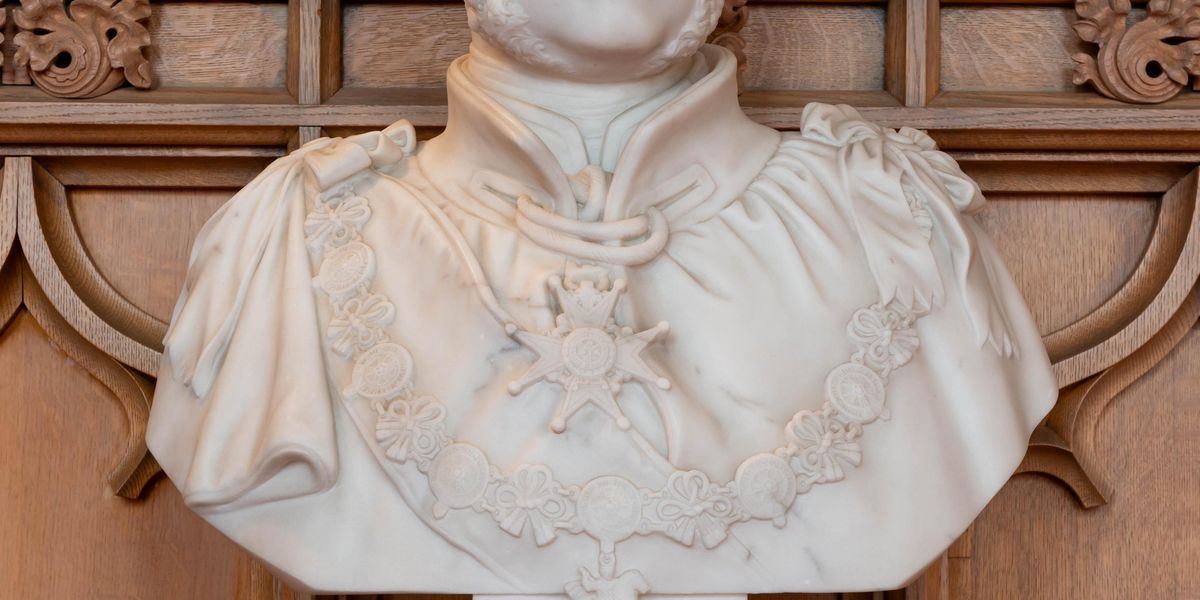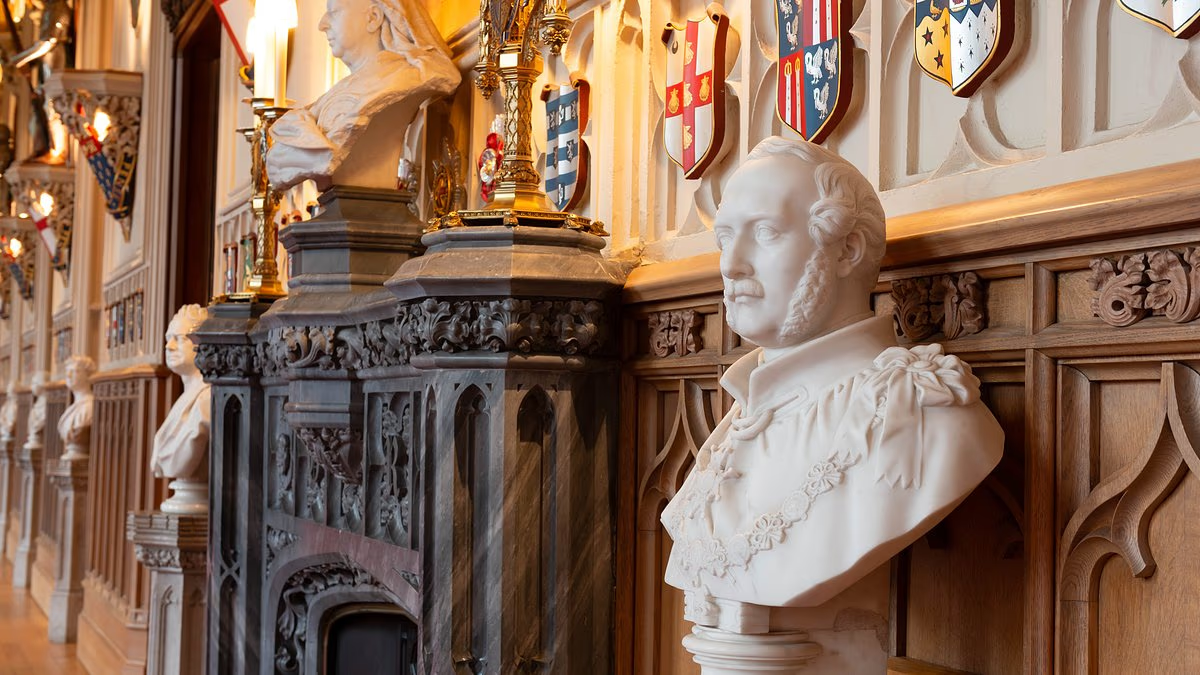
For more than 100 years, it has been among the treasures on display at Windsor Castle.The bust depicting Prince Albert - the tragic consort of Queen Victoria - was long believed to have been the work of a celebrated expert sculptor.But now, experts have discovered it was made by Albert and Victoria's daughter to commemorate her father after his untimely death aged just 42 in 1861. The remarkable likeness was crafted in stone by their eldest child Princess Victoria, unearthed correspondence reveals.The younger Victoria wrote to her mother from Berlin: 'It is a work which completely engrosses me… I feel very nervous… I hope you will like it. How I wish you were here to give advice!' Replying, the Queen said, 'I like it extremely,' adding only that the nose was a touch too thick. The Princess and her husband, the Crown Prince of Prussia, went on to give the sculpture to the Queen for Christmas in 1864. It then went on display in Windsor Castle's St George's Hall, where it remains. A bust of Queen Victoria's husband Prince Albert on display at Windsor Castle. Experts have discovered it was the work of the couple's eldest daughter Princess Victoria was 21 when her father died from typhusIt was thought to have been crafted by sculptor Robert William Sievier.But, during research, art historian Jonathan Marsden, who is the former director of the Royal Collection, determined the bust - which depicted Albert aged 23 - could not have been by Sievier.He then found the reference to the bust when he examined archival correspondence between Queen Victoria and her daughter.Mr Marsden made the discovery while doing research for the first comprehensive catalogue of sculpture in the Royal Collection.Queen Victoria was left bereft by Albert's death from typhoid fever. She famously wore black for the rest of her life and made only a handful of public appearances.Like her mother, Princess Victoria was very close to her father. They shared a love for learning and the arts, with sculpture being a particular mutual passion.Along with her sisters Princesses Alice and Louise, the Crown Princess took lessons in sculpting, and, perhaps fearing someone else would not do her 'dear Papa' justice, she created the posthumous bust with her tutor, Hugo Hagen.The bust discovery is among a number of revelations and new research published for the first time in the new catalogue, which has been 30 years in the making. The bust is on display inside St George's Hall at Windsor Castle Albert and Victoria in 1854 - the couple married in 1840Queen Victoria had a particular fondness for using sculpture to preserve the memory of growing children or lost loved ones. A bust of the young Prince Albert by Emil Wolff given by the Prince to his fiancée on their engagement in 1839 was kept by Queen Victoria next to her desk in her sitting room at Buckingham Palace for 60 years. However, in recent times its identity had been forgotten, and it was described as an 'unknown man'.Victoria also commissioned the successful female sculptor Mary Thornycroft to portray her growing family, even hiring her as a sculpting tutor for another of her daughters, Princess Louise, who became a notable sculptor in her own right. Thornycroft's work for the Queen was all the more impressive given she had seven children of her own between 1841 and 1853 and was still working on a bust of Princess Alice two days before giving birth to her own daughter.Art historian Jonathan Marsden, who is the former director of the Royal Collection, said: 'Sculpture can easily fade into the background, yet closer examination can reveal works of art of quality and significance with their own stories to tell.'By sharing our discoveries, both through the catalogue and online, we hope visitors to the palaces will have a renewed appreciation of these beautiful works of art and pieces of history. 'For researchers and specialists, the catalogue represents an important new body of evidence, the foundation for future scholarship.'Princess Victoria, the first of nine children Queen Victoria and Albert had together, died in August 1901, just seven months after her mother. The catalogue, titled European Sculpture in the Collection of His Majesty The King, is published tomorrow by Modern Art Press in association with the Royal Collection Trust.
Bust of Queen Victoria's husband Prince Albert was made by daughter
The bust depicting Prince Albert - the tragic consort of Queen Victoria - was long believed to have been the work of a celebrated expert sculptor.
715 words~3 min read