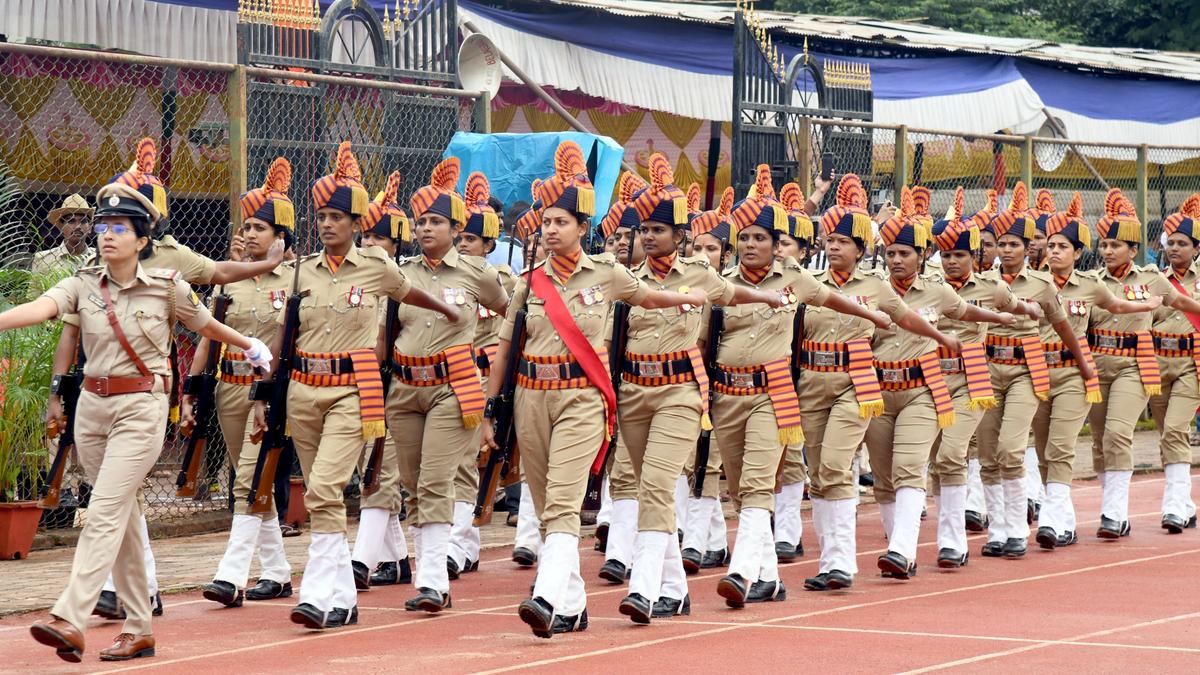
Karnataka has only 8.91% women in its police force, well below the national average of 12.73%, and far behind States like Bihar, which has the highest share at 23.66%. This is despite Karnataka reserving 25% of posts for women, a project study by the National Law School of India University (NLSIU), Bengaluru, has revealed.Not representation in investigating ranksNearly two-thirds of police stations in the State do not have a single woman officer in crucial investigating ranks of assistant sub-inspector (ASI), sub-inspector (SI) or police inspector (PI).As per the Karnataka Administrative Reforms Commission (KARC), at the present rate of recruitment and promotions, it will take the State more than 25 years to meet its own set target.Karnataka’s record over the past 16 years shows a not-so-steady progress. In 2007, women made up 5.44% of the police force. By 2016, the figure had crossed 6%. But instead of continuing the upward, it dipped again to 5% in 2017 — the same year when the Comptroller and Auditor General (CAG) flagged the shortfall, prompting the State to first set a 20% quota for women, which, in 2020, was raised to 25%.Even then, representation rose only slightly, crossing 8% by 2021, and has since stagnated. By 2023, women accounted for 8.91% of the force.This uneven trajectory is in contrast with States such as Bihar, Andhra Pradesh, and Tamil Nadu, where a steady rise has pushed women’s representation well beyond 20%. Karnataka, however, has fallen behind the national average of 12.32%, a gap that has only widened year-after-year since 2012. The NLSIU project study, which examined 202 police stations across eight districts, shows that only three police stations — two in Mysuru and one in Davangere — had a woman PI. Two of these were women’s police stations. Out of the 202 stations, 130 had no woman SI at all.In Tumakuru, only 12 out of 42 police stations had one woman SI. Tumakuru, Davangere and Vijayanagara districts did not have a single woman ASI.In total, only 72 of the 202 stations (36%) had at least one woman SI, while just nine had one woman ASI.HDIDistricts with higher female representation — Udupi, Kodagu, Dakshina Kannada and Chikkamagaluru — also rank high on Karnataka’s Human Development Index and Gender Inequality Index. Udupi and Kodagu report the highest share of women at 18%, while Vijayanagara and Kalaburagi have only around 10%.Rare in armed battalionsWhile Karnataka is among the few States in India where a woman officer has served as the State police chief, with 1983 batch IPS officer, Neelamani Raju, being appointed Director-General and Inspector-General of Police in 2017, women in the Karnataka State Police are overwhelmingly concentrated in the civil branch. Of the 9,081 women personnel, 8,937 are in civil police, making up 12.69% of that branch.In the armed battalions, they account for only 1.58%, unlike States like Bihar, Haryana and Jharkhand, which have already created all-women battalions.DAR has no womenThe District Armed Reserve in Karnataka has no women at all. The Karnataka State Reserve Police, which handles riot control and disaster response, first inducted 120 women constables in 2016.Numbers have since dwindled, with only 144 women across 12 battalions in 2023.However, Tamil Nadu has 6,966 women in its armed branch, and Kerala has nearly 20% of its women police in the armed wing.Women excluded from meaningful responsibilitiesThe project study by the National Law School of India University (NLSIU), Bengaluru, found that despite carrying a heavy share of routine police work, women are often excluded from meaningful responsibilities. They are kept out of investigations, including cases of sexual assault, and instead used for token appearances, such as accompanying survivors or being present during statements. Safety is another concern, especially during night duty. Women constables, in the study, described everyday barriers men rarely face. “Nearly 90% of work in the police station is done by women. Yet men think we don’t do any work,” said a woman constable in Mysuru.“No matter how much women work, it’s not counted,” said women constables interviewed during the study between 2021 and 2023. In Raichur and Chikkaballapura, more than 50 % expressed discomfort. Toilets remain a major issue. During bandobast duties, many women avoid drinking water because of the lack of clean washrooms. Most participants across focus groups acknowledged that inappropriate comments, gestures, or behaviour were common within the department. However, very few felt comfortable speaking about it openly, fearing retaliation or dismissal by senior officers, the project study noted. Women constables said they are ready to handle all kinds of tasks if only basic facilities like access to two-wheelers during bandobast are provided. Devyani Srivastava, Senior Manager (Research) and project lead, NLSIU, said, “Achieving gender parity is not just a constitutional requirement, it is an operational imperative. A police institution with diverse skill sets and lived experiences is better equipped to respond to safety challenges of today. While increasing the share of policewomen is a crucial first step, ensuring gender-responsive policies, facilities, training and infrastructure, at all levels, must go hand in hand for meaningful outcomes.”
Karnataka has just 8.9% women in police force, far behind Bihar, Andhra Pradesh, Tamil Nadu: NLSIU study
Karnataka has only 8.91% women in its police force, well below the national average of 12.73%, and far behind States like Bihar, which has the highest share at 23.66%. This is despite Karnataka reserving 25% of posts for women, a project study by the National Law School of India University (NLSIU), Bengaluru, has revealed.
835 words~4 min read