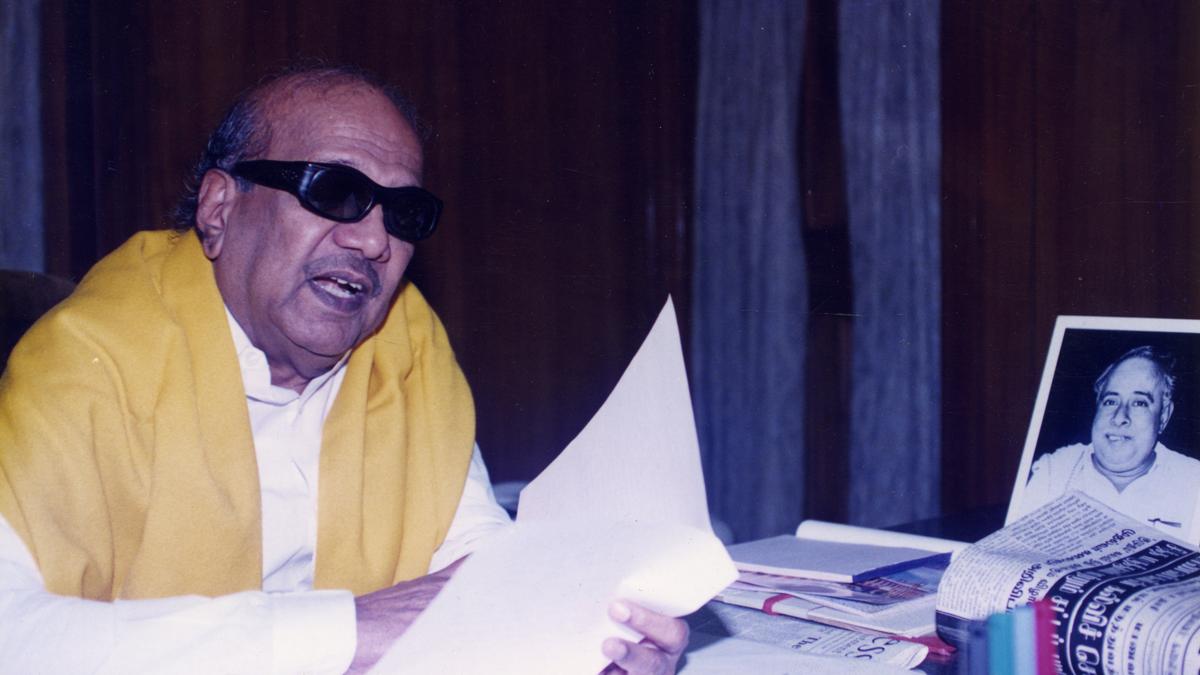
M. Karunanidhi. File
| Photo Credit: The Hindu Archives
Way back in August 1996, the then DMK government in Tamil Nadu headed by M. Karunanidhi issued a Government Order (G.O.) setting up a high-level committee to review the standard of education. The committee recommended 15 per cent reservation for students studying in panchayat schools in rural areas for admission to professional courses. Subsequently, in December 1997, another G.O. extended the 15 per cent reservation to medical courses from the following academic year. It was later extended to law courses as well. The policy was in force for a couple of years.In 2001, the AIADMK led by J. Jayalalithaa came to power and soon after, the government increased the quota from 15 to 25 per cent.Several writ petitions were filed before the Madras High Court by aggrieved parties challenging the G.O. In February 2002, the Madras High Court ruled the G.O. was unsustainable. The Bench comprising the then Chief Justice of Madras High Court, B. Subhashan Reddy and Justices K.P. Sivasubramaniam and K. Ravirajapandian stated that besides the fact that rural reservation could not sustain, the increase in reservation would not stand Constitutional scrutiny.“For the foregoing discussion, we hold that the rural reservation provided at first with 15% and then extending to 25% for admission in professional colleges in the State of Tamil Nadu, by issuance of the impugned Governmental orders by the Government, has got absolutely no nexus to the object to be achieved and there is no intelligible differentia either and that the Government has failed to justify the discrimination and as such they are invalid being infractive of Article 14 of Indian Constitution and are hereby set aside,” the Bench held. The court also directed the government to approach the Medical Council of India and the Bar Council of India for additional seats to offset the differential arising out of those given admission under the policy.Tamil Nadu government was quick to file a Special Leave Petition in the Supreme Court against the High Court’s pronouncement. It held that horizontal reservation was intended to protect the underprivileged who could not be treated on a par with the privileged, urban students. The SLP maintained that the classification was made based on social and educational backwardness of the students who studied in schools run by village panchayats. Tamil Nadu’s submission also stated that the direction of the High Court to create additional seats was inconsistent with Supreme Court judgment in the Rajiv Kapoor case.The Supreme Court, however, declined to stay the Madras High Court’s judgment. Consequently, the 25% quota for rural students was not implemented thereafter.After nearly two decades, the Tamil Nadu government, this time headed by the AIADMK’s Edappadi K. Palaniswami, unanimously passed a Bill in September 2020 in the Legislative Assembly seeking to provide 7.5 per cent horizontal reservation for government school students on a preferential basis for National Eligibility-cum-Entrance Test (NEET) qualified candidates. This was based on recommendations of a Commission headed by retired High Court judge P. Kalaiyarasan.The Commission had observed that students from government schools are disadvantaged compared to those in private schools “due to a cognitive gap created by socio-economic factors such as caste, wealth, parental occupation, parental education, gender etc., and these psychological and socio-economic barriers cannot be bridged by a few months of intensive coaching for NEET, even if provided for free”. It recommended 10 per cent reservation for government school children but the government preferred to offer 7.5 per cent quota.