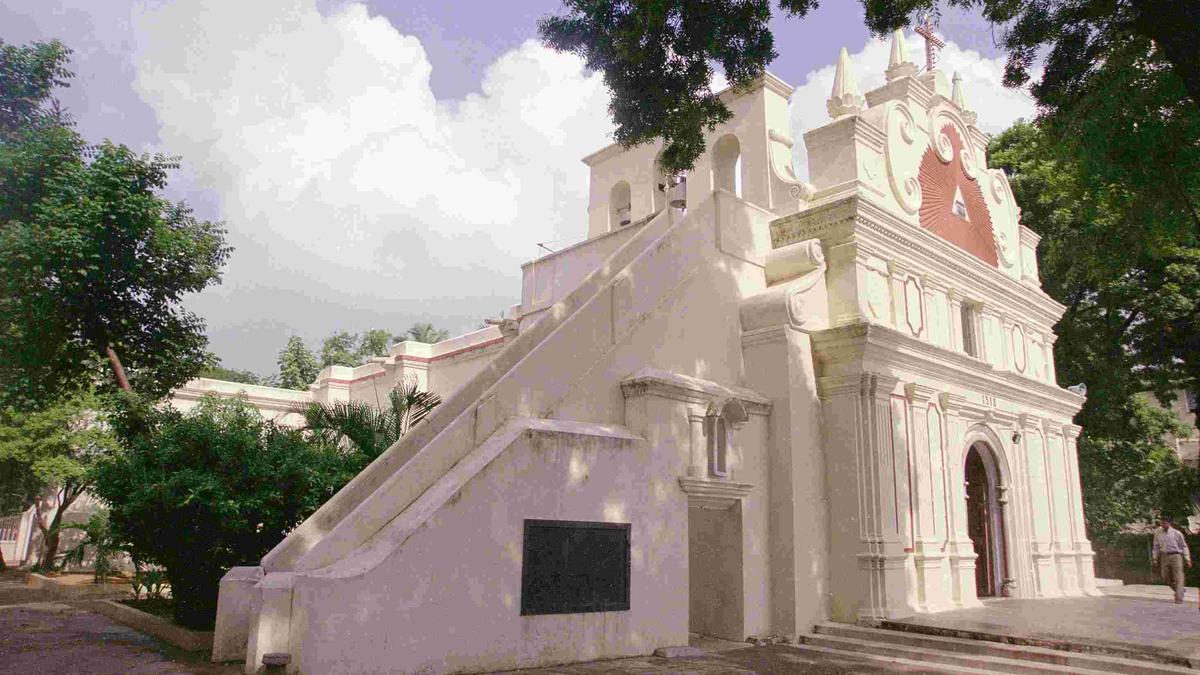
The Luz Church, also known as Kattu Koil, takes its Indian name from the fact that it was once in a dense forest. It still retains its baroque architecture.
| Photo Credit: The Hindu Archives
For over 300 years, i.e, between the Chola era of prosperity and the glory years of Vijayanagar, the Madras region seems not to have had many visitors from overseas. But by the 16th Century, the Portuguese were here and were the first among the significant colonial presences. While there is no doubt that it was trade that brought them to India, my contention is that it was the strong link with the legend of St. Thomas that drew them to Mylapore. Under them, the area proved a blueprint for colonial forts — a white town by the sea and a black one to the west. They called it San Thome, after the saint who brought them here.The Portuguese were as inspired by evangelisation as they were by conquest, and so both flourished. There were as many as seven churches within the fort, and four outside of it. Today, among the former, we have the San Thome basilica (much reconstructed and bearing no trace of Portuguese architecture) and the Rosary Church as two survivors, with a third, St. Rita’s now part of the San Thome Matriculation School. Its façade remains unchanged. Surprisingly, all four churches outside the fort survived — St. Lazarus, Madre de Deus, Descanso, and Luz. Among these, the Luz Church, also known as Kattu Koil, takes its Indian name from the fact that it was once in a dense forest. It still retains its baroque architecture.