This article is part of FT Globetrotter’s guide to New York
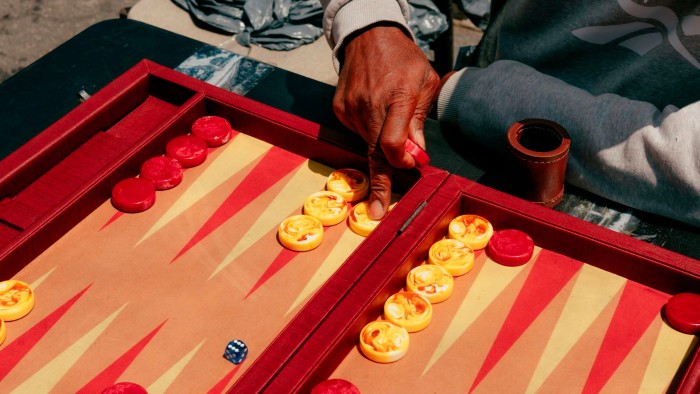
For years, I’ve spent my Saturdays in a dark room in Brooklyn, staring at triangles. I spend them celebrating and arguing with friends and strangers alike. I spend them building barricades and avoiding capture. I spend them rolling dice on to baize and calculating combinatorics and probabilities and moving circular pieces. I spend them consulting neural networks to settle spirited debates. I do all of this because I am a player of backgammon, the finest board game ever invented.
The game is great because it is perfectly and doubly balanced — between luck and skill, between simplicity and depth. It is the apotheosis of “a minute to learn, a lifetime to master”. Indeed, the game’s combination of race and battle has occupied humans for millennia, and occupies them today in robust numbers across New York. Tracing them through the bars, clubs and parks that host these games frames an excellent tour of the city.
A board at the Clinton Hill Backgammon Club in Brooklyn
We might begin in a secluded corner of the Greek and Roman wing of the Metropolitan Museum of Art, on Manhattan’s Upper East Side, where a dozen terracotta balls sit. They are small and unassuming things, like stones that rolled in from Central Park and were swept up and placed behind glass. In reality they may be game tokens, likely for something similar to backgammon, and they are thousands of years old. Dice in particular, the museum’s text reads, were fixtures of ancient life. They remain part of the material of New York, skittering every day on tabletops across town.