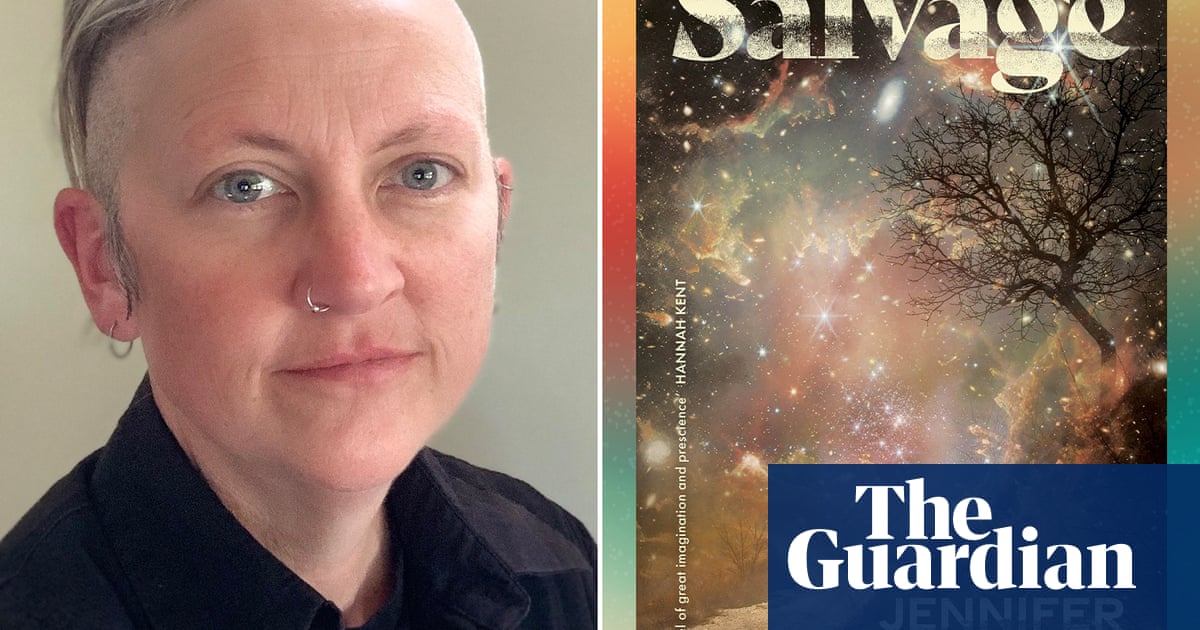
In her mesmerising fifth novel set in the near-future, the Australian author offers a timely model of resistance to despair and passivity
W
hat does it mean to build a new world from the wreckage of a broken one? This question lies at the heart of Jennifer Mills’ mesmerising fifth novel, Salvage – but it’s one that her gruff, defensive protagonist Jude would rather avoid. For most of the novel, Jude has her head down and is hard at work, cooking, fixing engines, caring for other people. She’s a survivor whose adaptative mechanisms involve leaving everything and everyone behind: “Things will be simpler when she’s on her own. Belonging nowhere, carrying nothing.”
We meet Jude in the village of Northport in the Freelands, on the precipice of a dangerous journey, a narrative moment that both anticipates resolution, and disorients the reader. Mills doesn’t rush to explain how Jude got to Northport or where she’s going; the plot is revealed slowly through the novel’s intricate design. Although Jude tries to convince her friends to stay away, to her immense vexation they won’t let her play the role of the lonely hero – and Mills, anyway, has no truck with narrative models organised around a single exceptional protagonist.