https://arab.news/gsy7f
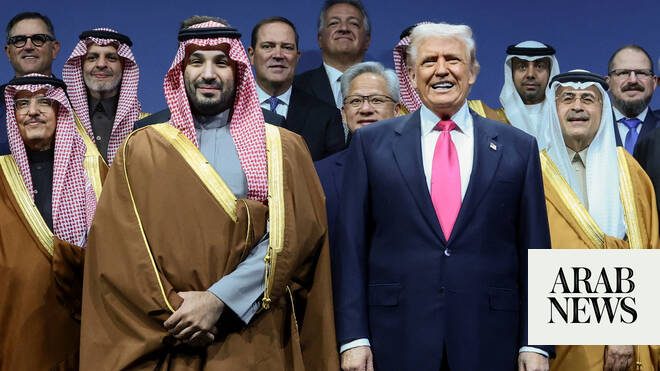
President Donald Trump’s historic visit to Saudi Arabia was not merely another high-profile diplomatic stop. It was a signal, one that reverberates far beyond ceremonial pageantry or economic accords. With a sweeping agenda anchored in regional security and technological advancement, the visit marked a profound turning point: the introduction of artificial intelligence as a centerpiece in reimagining international alliances and national futures.
As Saudi Arabia deepens its strategic commitment to AI, the spotlight now turns to a less discussed — yet far more consequential — question: Who truly owns the AI revolution?
For too long, the narrative has belonged to technologists. From Silicon Valley labs to national AI strategies, the story of AI has been told in the language of algorithms, architectures, and compute. And while the technical infrastructure is essential, we argue that such a narrow view of AI is not only incomplete, it is dangerous.
When the American Institute of Artificial Intelligence and Quantum was launched in the US in 2016, the institutional landscape for AI was highly specialized. Data scientists, computer engineers, and mathematicians dominated the discourse. Policymakers and business leaders, overwhelmed by complexity, often stood at a distance. AI was regarded as something technical — a toolset, a model, an optimization system.