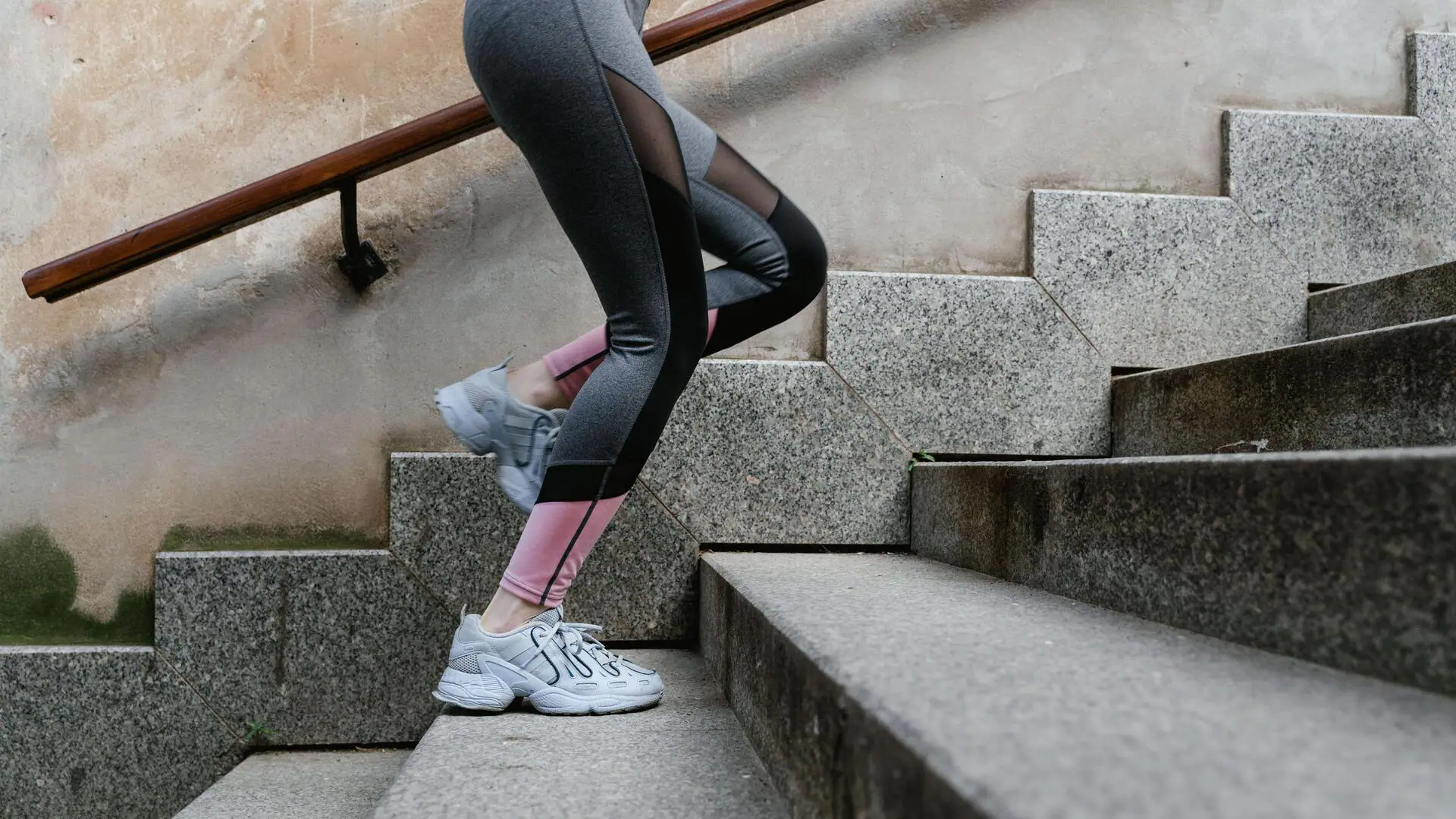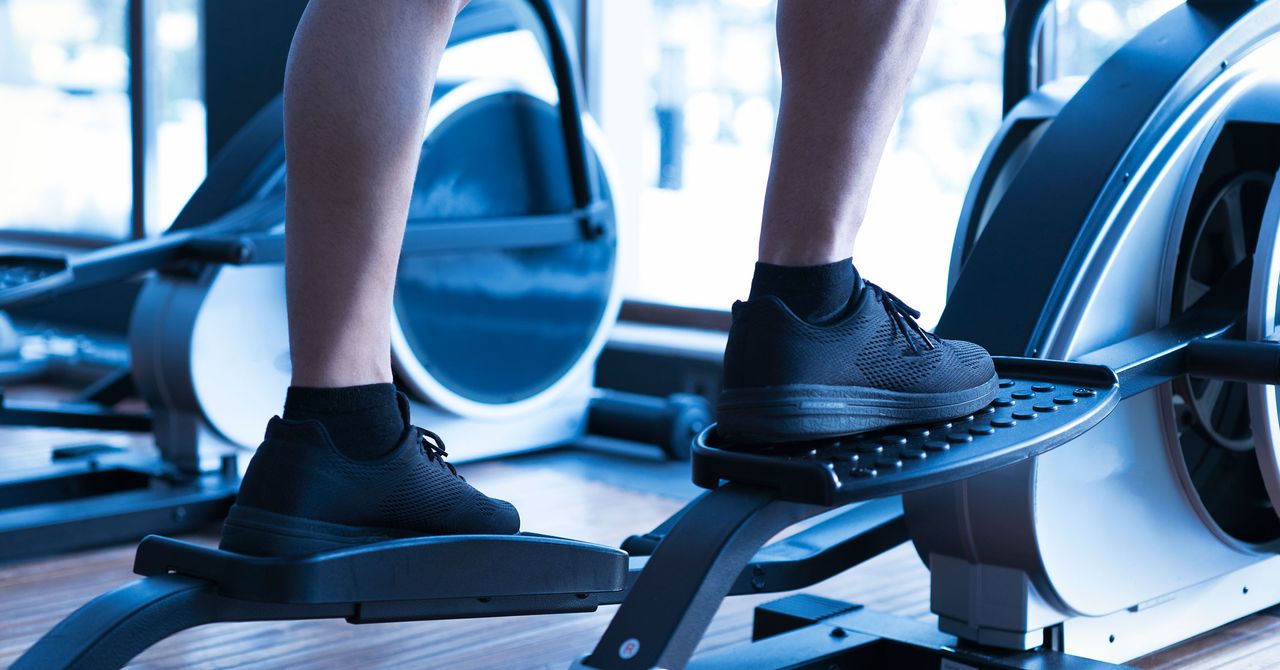
YOU CAN GET a great workout by walking up the stairs in a tall building. The only problem is that you can’t watch TV while doing it—hence the popularity of stationary stair-climbing machines. But is it the same? If your goal is to burn calories, does it make any difference which you choose? That’s actually a great physics question, and we can get a pretty good mental workout with it. Shall we?
OK, what is a calorie, anyway? It’s a unit of energy, defined as the amount of energy needed to raise the temperature of 1 liter of water by 1 degree Celsius. (This is your common “food calorie”: chemists confusingly use a calorie measure that’s 1,000 times smaller.) Of course, in physics we prefer to measure energy in joules. Just to give you a feel for this unit, if you lift a textbook from the floor to a table, that would take about 10 joules.
Now, the work-energy principle says that in order to change the energy of a system, you need to add energy to (or remove energy from) the system. That seems obvious, but it’s actually useful. We call the energy input (or output) “work.” Work is done on a system by applying a force over some distance.
Let's go back to the case of lifting a book off the floor. The first thing we need to do is define our “system.” That tells us what kinds of changes in energy we’re going to deal with. So I'm going to use the system consisting of the book and the Earth. Since the book can move, it can have kinetic energy (K), which depends on its mass (m) and velocity (v). And with Earth in the system, we can also have gravitational potential energy (U). This depends on the mass of the book, the gravitational field (g), and the height of the book above the floor (y).